

Mentoring Scheme Award
Application code: MSA 25-01-15
Organisation 1: AS Metrosert, Estonia
Organisation 2: INRIM, Italy
Training of a Metrosert researcher at INRIM in the field of single photon emitters for metrological applications
Main purpose was to learn how to generate reliable and stable single photon streams from a color-center-based sources so that similar techniques can be exploited at Metrosert. These sources include e.g. nitrogen-vacancies (NV) in diamond, point-defects in SiC and G-centres in Si. The work concentrated on practical activities at INRiM to locate and characterize various single photon emitters at different structures.
During the first period (1 week) of the visit the emphasize was to study NV-centres in bulk diamond. A special sample provided by the company Qnami was used for this purpose. The sample contains thousands of symmetrically positioned nano-pillars etched into a diamond substrate. Each pillar, which act also like waveguide, contains on average 1-2 NV-centres giving high probability of having true single emitters in hundreds of pillars.
For the Metrosert employee it was important to learn the parameters used for such kind of experiment, e.g. the excitation wavelength, power and type (CW or pulsed), sample resolution, specific properties of optical components (dichroic mirror, objective), data acquisition parameters, etc.
Figure 1 depicts the obtained confocal map of the sample. The fluorescing NV-centres correspond to the positions of the pillar tips. Few of the best emitters were selected for deeper analysis. On the right side of Figure 1 a g(2)(t) function for a good emitter is shown indicating g(2)(0) value below 0.3.
Figure 1. Left: 80×80 mm confocal fluorescence map of INRiM Qnami sample. Right: indicative g(2) function (measured: blue dots; fitted: red line) for the emitter marked with C1 on the left side. Time scale has an offset of 75 ns due to delay line in the optical collection system.
In the second period (2 weeks) the joint work continued in the laboratory concentrating on studying samples with point defects in Si and SiC. These samples were freshly provided by the University of Torino (UNITO) and Heriot-Watt University and were also new to the INRiM personnel, thus finding good or any emitter wasn’t guaranteed. The experiments with these samples required low temperatures on the level of about 10 kelvins. A special cryostat with optical access and integrated nano-positioners was used for this purpose. INRiM personnel showed how to mount the samples into the cryostat and explained each section of the setup and steps taken during the measurements.
Figure 2. Left: Photo of the Si and SiC substrates (semi-transparent rectangular shapes at the centre) mounted on to a sample holder prior inserting into cryostat. Right: Opened cryostat with the inserted sample holder (edge is visible). Beam enters from the right side via objective. Scattered green light indicates the beam entrance position.
With several days of efforts unfortunately no emitting centres were able to be found from these specimens.
During this period Metrosert employee had also chance to visit UNITO ion implanter. This facility is actively used to prepare test samples for INRiM researchers for studying colour centres in various materials.
Figure 3. Visiting UNITO ion-implanter. Sviatoslav from UNITO is explaining the apparatus.
Outcome and impact
With this mentoring grant Metrosert employee learned how to investigate various single photon emitters (mostly NV-centres in diamond but also point defects in Si and G-centres in SiC). The work included installing the samples into the optical system, aligning and adjusting the confocal optical setup, learning the procedures and techniques to find suitable emitters, performing the measurements. Evaluating the quality and brightness of different single photon emitters. Gained knowledge on procedures and methods for manufacturing colour centres using ion implantation.
Along with this partnership Metrosert has now better understanding about the possibilities and techniques needed to establish experimental facility for generating and detecting single photon streams with high efficiency. This will help Metrosert to establish services for single photon device calibrations and maintain and improve in house knowledge on single photon metrology.
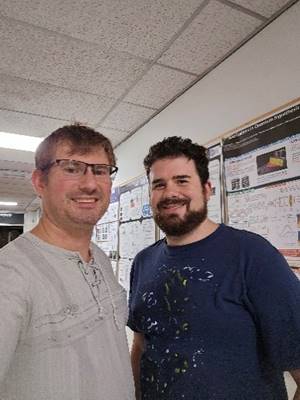
Figure 4. Meelis from Metrosert (left) and Enrico from INRiM (right) during the visit.